
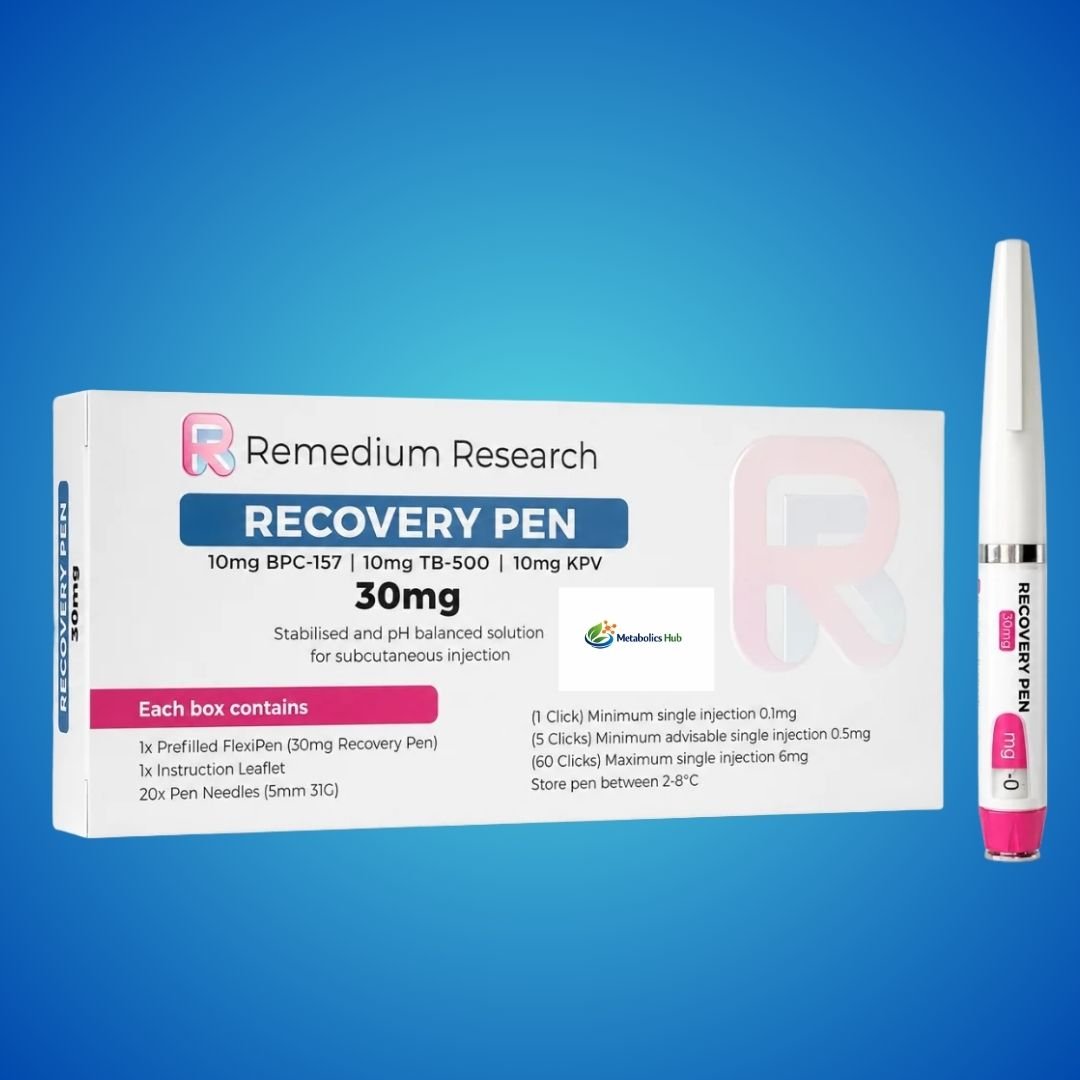
Remedium Recovery Pen 30mg: UK Research & Information Guide
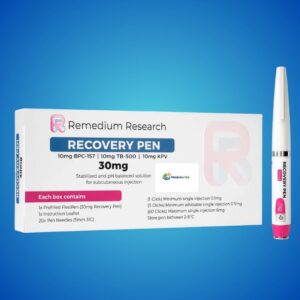
The Remedium Recovery Pen 30mg is a research peptide formulation associated with a three-peptide blend of BPC-157, TB-500 and KPV. Product information available online describes the formulation as containing 10mg of each peptide, giving a stated total peptide content of 30mg. It is presented for laboratory and research applications rather than as an authorised treatment for human use.
For UK audiences, it is important to distinguish scientific research from approved medical treatment. BPC-157, TB-500 and KPV have attracted interest in laboratory research, but evidence from experimental models should not automatically be interpreted as proof of safety or effectiveness in people.
What Is the Remedium Recovery Pen 30mg?
The Remedium Recovery Pen 30mg is a pre-filled peptide research formulation designed around three compounds that have been investigated in different areas of peptide and cellular research.
The product information identifies the three components as:
- BPC-157 – 10mg
- TB-500 – 10mg
- KPV – 10mg
- Total stated peptide content – 30mg
The pen format is intended to provide a combined research formulation rather than requiring researchers to work with three separate peptide preparations. The stated 30mg refers to the total labelled peptide content and should not be interpreted as a recommended human dose.
BPC-157 Research
BPC-157 is a synthetic pentadecapeptide that has been investigated extensively in preclinical research. Studies have explored its biological activity in models involving tissue responses, cellular signalling and inflammatory processes.
However, the distinction between laboratory findings and established clinical medicine is important. A recent 2026 review concluded that BPC-157 remains at an early stage of pharmaceutical development, with no approved formulation, no validated dosing regimen and insufficient completed clinical research to establish its therapeutic use.
For this reason, website content should avoid describing BPC-157 as a clinically proven recovery treatment.
TB-500 and Thymosin Beta-4 Research
TB-500 is commonly discussed in connection with thymosin beta-4-related research. Thymosin beta-4 is a naturally occurring peptide that has been studied for its relationship with cellular movement, actin regulation, tissue responses and repair-related biological processes.
Research reviews have explored thymosin beta-4 in areas including tissue repair, regeneration, cell migration and wound-related biology. Some clinical research has also investigated thymosin beta-4, but these findings should not be treated as evidence that every TB-500-labelled product has an established medical indication.
The exact identity, composition and quality of any TB-500-containing research material should therefore be confirmed through appropriate product documentation and analytical testing.
KPV Peptide Research
KPV is a short tripeptide derived from the C-terminal sequence of alpha-melanocyte-stimulating hormone. Research has investigated KPV in relation to inflammatory signalling and intestinal cellular pathways.
Experimental studies have reported effects involving inflammatory pathways such as NF-kB and MAP kinase signalling, including research using intestinal cells and animal models. These findings are scientifically interesting, but they remain experimental and should not be presented as proof that KPV treats inflammatory conditions in humans.
Why Is This Combination Studied?
Combining BPC-157, TB-500 and KPV creates a multi-peptide research formulation that can be investigated in experimental models involving different biological pathways.
Researchers may be interested in comparing individual peptides with combined formulations, examining peptide stability, studying cellular signalling or evaluating interactions between different compounds.
Importantly, the existence of several peptides in one formulation does not establish a proven combined therapeutic effect. Each compound has its own evidence base, limitations and research history.
Remedium Recovery Pen 30mg in the UK
UK websites should present research peptides accurately and avoid language that implies an unlicensed product is an approved medicine.
The MHRA states that medicines that are not licensed cannot be advertised, and prescription-only medicines cannot be advertised to the general public. The agency also specifically includes promotional information published on company websites within the scope of medicines advertising.
Accordingly, a compliant UK product page should focus on factual research information, product identification and scientific background rather than promises of recovery, healing, pain relief or guaranteed results.
Product Quality and Research Documentation
Researchers should pay attention to documentation accompanying peptide materials. Relevant information may include batch identification, stated composition, analytical testing, storage requirements and supplier documentation.
Where available, independent analytical information such as HPLC or mass-spectrometry results can help researchers assess the identity and purity of a research material. Analytical testing, however, does not establish clinical safety or effectiveness.
Frequently Asked Questions
What is Remedium Recovery Pen 30mg?
It is a research peptide formulation identified by product information as containing BPC-157, TB-500 and KPV, with 30mg total stated peptide content.
What peptides are in the Recovery Pen?
The listed formulation contains BPC-157 10mg, TB-500 10mg and KPV 10mg. Always verify the current product label and batch documentation.
Is the Remedium Recovery Pen 30mg an approved UK medicine?
Do not assume that a research peptide product is an MHRA-authorised medicine. UK medicines must meet the applicable licensing and advertising requirements.
Does 30mg mean a human dose?
No. The 30mg designation describes the stated total peptide content of the formulation. It should not be interpreted as dosing or treatment advice.
What is BPC-157 researched for?
BPC-157 has primarily been studied in preclinical research involving cellular, molecular and tissue-response mechanisms. Clinical evidence remains limited.
Final Thoughts
The Remedium Recovery Pen 30mg is best described as a multi-peptide research formulation containing BPC-157, TB-500 and KPV according to available product information. These peptides have generated scientific interest across cellular signalling, inflammatory pathways and tissue-response research, but the available evidence does not justify presenting the formulation as a proven human recovery treatment.