
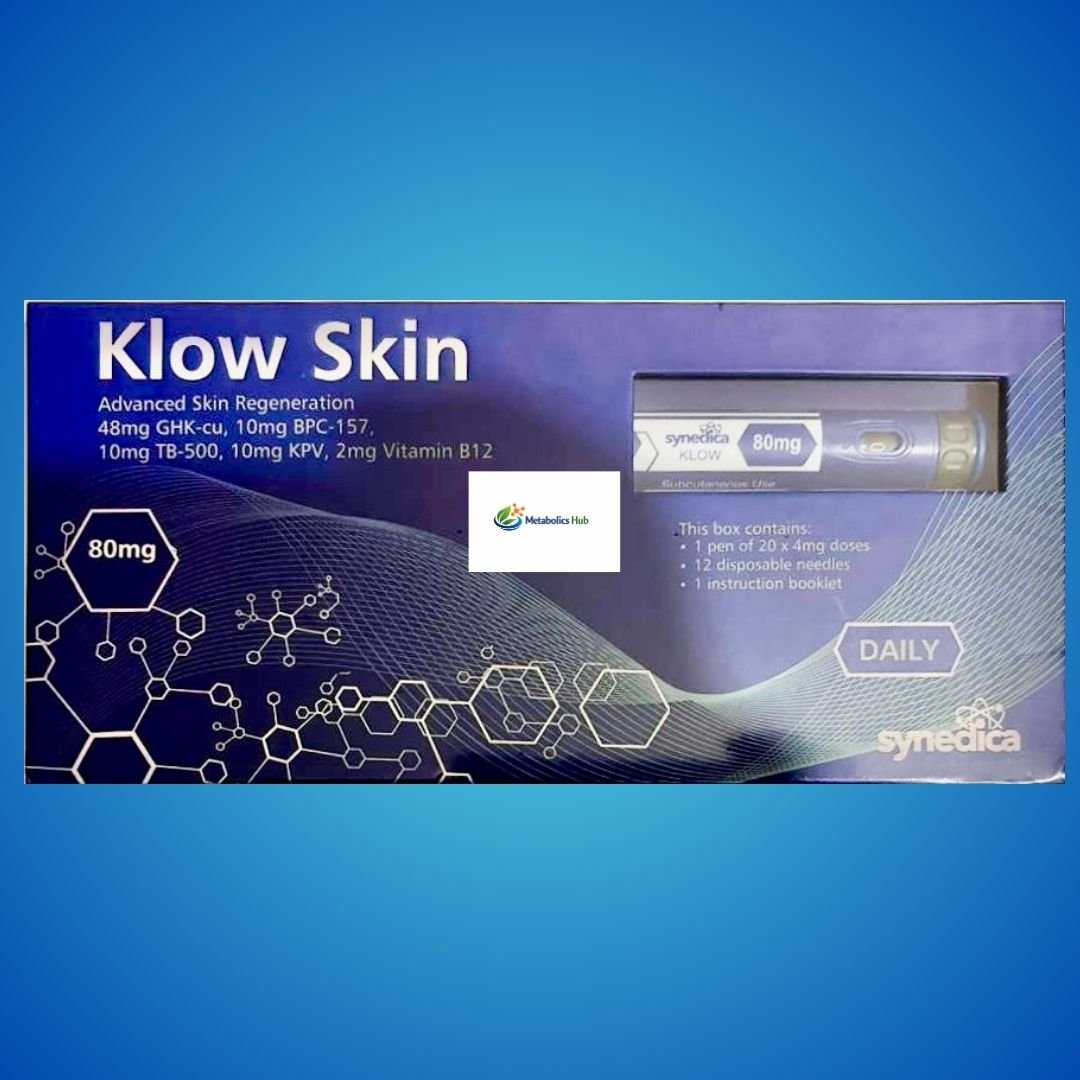
Synedica Klow Skin 80mg Pen
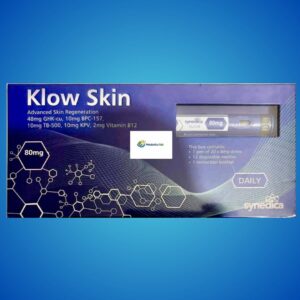
The Synedica Klow Skin 80mg Pen is a product name associated with KLOW, a multi-peptide research formulation that has attracted interest in skin biology, tissue-repair and inflammation research. KLOW is commonly described as a combination of four distinct peptides: GHK-Cu, BPC-157, TB-500 and KPV. The commonly reported 80mg formulation contains 50mg GHK-Cu, 10mg BPC-157, 10mg TB-500 and 10mg KPV.
For UK consumers researching the Synedica Klow Skin 80mg Pen, it is important to distinguish between research compounds and authorised medicines. Evidence relating to individual peptides should not automatically be interpreted as evidence that the complete KLOW combination has been proven effective or safe for human use.
What Is Synedica Klow Skin 80mg Pen?
The Synedica Klow Skin 80mg Pen refers to a pen-format product associated with the KLOW peptide blend. Online research-product descriptions commonly identify KLOW as a four-peptide combination containing GHK-Cu, BPC-157, TB-500 and KPV.
The 80mg figure refers to the total stated peptide content of the commonly described KLOW formulation. It does not represent a recommended human dose.
Importantly, the exact composition of a particular commercial product should always be confirmed from its own product documentation. Different manufacturers may use different specifications, concentrations, packaging and quality-control procedures.
What Peptides Are Associated With KLOW?
KLOW is generally described as containing four chemically distinct peptides.
GHK-Cu is a copper-binding peptide that has been investigated in relation to collagen, extracellular-matrix activity and skin biology.
BPC-157 is an experimental peptide that has primarily attracted attention through preclinical research involving tissue-repair pathways.
TB-500 is a peptide associated with research into thymosin-beta-4-related biological pathways, including cellular migration.
KPV is a small peptide fragment associated with research into inflammatory signalling.
These research areas are based largely on studies of individual compounds. They should not be interpreted as proof that combining all four peptides creates a clinically established treatment.
GHK-Cu and Skin Research
GHK-Cu is particularly relevant to the skin-related interest surrounding KLOW. Research has investigated the peptide’s interaction with copper and its possible involvement in extracellular-matrix processes.
Experimental work has examined pathways associated with collagen and other structural components of skin. This scientific background helps explain why copper peptides are frequently discussed in cosmetic and skin research.
However, evidence concerning GHK-Cu alone cannot establish the effectiveness of the complete Synedica Klow Skin 80mg Pen formulation.
Consumers should therefore avoid interpreting laboratory findings, cosmetic research or preclinical studies as guaranteed results from a specific commercial product.
BPC-157 and TB-500 Research
BPC-157 and TB-500 are frequently discussed in peptide research communities because of experimental research involving tissue-repair and cellular processes.
Much of the evidence surrounding BPC-157 comes from laboratory and animal research rather than high-quality human clinical trials. Similarly, research involving thymosin beta-4 should not automatically be treated as evidence for every product marketed as TB-500.
This distinction is particularly important when evaluating a multi-peptide formulation. Research involving one component does not demonstrate that the complete combination produces the same effect.
KPV and Inflammation Research
KPV is a short peptide associated with the C-terminal portion of alpha-melanocyte-stimulating hormone. Experimental research has examined its relationship with inflammatory signalling.
This has contributed to KPV being included in some research formulations described as having an inflammation-related focus.
Nevertheless, research findings should be interpreted within their scientific context. A mechanism observed in laboratory or animal studies does not establish that a commercially marketed peptide pen is an approved treatment for inflammation or skin conditions.
Synedica Klow Skin 80mg Pen UK Information
People searching for Synedica Klow Skin 80mg Pen UK should carefully check the regulatory and product status of the specific item they are researching.
The MHRA provides an official UK database where consumers can search medicines, active substances and marketing-authorisation information.
A product appearing on an online store does not automatically mean that it is an authorised UK medicine. The MHRA also provides a service for checking suspicious online medicine sellers and warns that unauthorised products may be fake or pose health risks.
For this reason, consumers should distinguish between a product marketed for research purposes and a medicine authorised for human treatment.
Product Quality and Authenticity
Product quality is an important consideration when researching peptide products. Consumers should look for clear information about the manufacturer, stated ingredients, batch identification, analytical testing and intended use.
A certificate of analysis can provide information about a particular batch, but it should not be interpreted as proof that a product is an authorised medicine or clinically effective treatment.
The physical appearance of a pen or its packaging also cannot independently confirm the identity, purity or sterility of its contents.
Safety Considerations
The safety profile of a specific KLOW combination cannot be assumed from research involving its individual components. Available online research descriptions acknowledge that the complete four-peptide blend has not been adequately evaluated in controlled human studies.
People should therefore be cautious about claims concerning guaranteed skin improvement, tissue repair, anti-inflammatory effects or other therapeutic outcomes.
Anyone considering treatment for a medical or dermatological condition should speak with an appropriately qualified healthcare professional rather than relying on research-product marketing.
Frequently Asked Questions
What is Synedica Klow Skin 80mg Pen?
It is a product name associated with an 80mg KLOW peptide formulation. KLOW is commonly described as containing GHK-Cu, BPC-157, TB-500 and KPV.
What does KLOW 80mg contain?
The commonly reported formulation contains 50mg GHK-Cu, 10mg BPC-157, 10mg TB-500 and 10mg KPV. The exact formulation of a specific product should always be verified independently.
Is KLOW an approved UK medicine?
Consumers should not assume that KLOW is an authorised UK medicine. The MHRA Products database should be used to check the regulatory status of authorised medicines.
Is KLOW clinically proven for skin improvement?
No. Research involving individual KLOW components should not be presented as clinical proof that the complete combination improves skin in humans.
What should UK consumers check?
Check the manufacturer’s information, exact formulation, batch documentation and regulatory status. For medical treatment, seek advice from an appropriately qualified healthcare professional.
Final Thoughts
The Synedica Klow Skin 80mg Pen is associated with a multi-peptide KLOW formulation containing GHK-Cu, BPC-157, TB-500 and KPV. Interest in these peptides comes from different areas of laboratory and preclinical research, particularly skin biology, extracellular-matrix processes, inflammation and tissue-repair pathways.
For UK readers, it is essential to separate scientific research from marketing claims. The existence of research into individual peptides does not establish that the complete KLOW blend is a proven medical treatment. Checking reliable regulatory information and obtaining professional healthcare advice are important when evaluating any peptide product.